Chiropractic
What is Chiropractic?
Chiropractic
is a complete system of healthcare focused on restoring, preserving,
and optimizing health by natural hands-on care.
Where
conventional or "allopathic" medicine focuses on curing illness through
surgery and pharmaceuticals, the goal of chiropractic is to optimize
health with a non-invasive approach that does not use drugs or surgery.
Chiropractic's primary avenue of care is manipulation of the spine and
the framework of the body.
The
spine is an important structure that houses and provides protection for
the spinal cord, while providing mobility for the upper body. This dual
requirement of strength and flexibility makes the spine a very complex
structure, with multiple joints at each spinal segment (the vertebrae)
forming the spinal column.
When these joints (also known as
articulations) are not positioned or functioning normally, it can
affect the nerves exiting the spine. Chiropractic care attends to
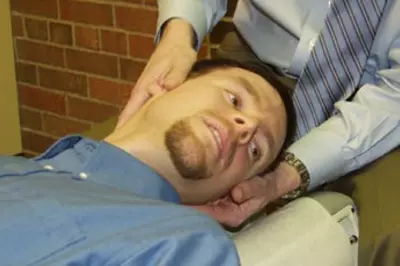
irritations along the spine by manually repositioning these joints.
This is a chiropractic "adjustment."
The word "chiropractic"
comes from the Greek words cheir (hand) and praxis (action), and simply
means "done by hand." Note that the word "chiropractic," while a bit
awkward, is the actual name of the profession. A chiropractor practices
chiropractic (not chiropracy, chiropractics, or even chiropractic
medicine).
Chiropractors are licensed professionals who are trained to diagnose and appropriately care for or refer patients for the care they require. Accordingly, they continually assess their patients from dual perspectives, asking: What might I do for you, as well as, what might you also need today beyond my abilities?
Chiropractic patients often visit their chiropractor periodically in order simply to relieve irritations - to get "adjusted." Individuals also seek chiropractic care for back pain, headaches, joint pain, carpal tunnel syndrome, tendonitis, sprains, as well as non-musculoskeletal conditions including allergies, asthma, and digestive disorders. Some chiropractors further specialize in orthopedics, sports injuries, neurology, pediatrics, nutrition, internal disorders, or diagnostic imaging.
What is the underlying philosophy?
Due to its
focused hands-on attention to the spine, the profession is often
thought of by its tools and by its avenue of care. Chiropractic,
however, is not just about manual care of the spine, although it has
certainly built a reputation caring for that often troublesome piece of
anatomy. In chiropractic, care of the spine and nervous system (which
is of fundamental importance in human health) is the way to optimize
the health of the whole human system and not just a means to relieve
back complaints.
A basic philosophy of chiropractic is that the
body naturally seeks the proper balance among all the systems of the
body, and that these systems are meant to work together. A second basic
principle is that proper structure is necessary for proper function. If
a structure is impaired by injury or stress, its function can be
adversely affected.
For
example, when our spine (structure) is not positioned normally, it can
irritate the nerves exiting the spine. And when spinal nerves are
irritated, they don't function normally and can affect the function of
the tissues they interact with. This "end-organ" effect is the central
interest in chiropractic care. The relief of localized discomfort at
the point of irritation is also an objective of care.
Thus chiropractic focuses on the integrity of the spine and its surrounding tissues as a means to enhance normal human function and health.
References
Chapman-Smith, D. A. (2000). The chiropractic profession: Its education, practice, research and future directions. West Des Moines, IA: NCMIC Group Inc.
Cherkin, D.C., Mootz, (Eds.). (1997). R.D.Chiropractic in the United States: Training, practice, and research. AHCPR research report. Rockville, MD.: U.S. Dept. of Health and Human Services, Public Health Service, Agency for Health Care Policy and Research.
Sportelli, L. (2004). Introduction to chiropractic: A natural method of health care (11th ed.). Palmerton, PA: Practice Makers Products.
- Where Does Chiropractic Come From?
- What are the Basic Concepts?
- Is Chiropractic Integrative, Alternative, or Mainstream?
- How Can Chiropractic Help Me?
- What Happens at the Chiropractor?
- Are There Any Safety Concerns?
- What Does the Research Say?
- Is Chiropractic Regulated?
- How Can I Find a Qualified Chiropractor?
- Where Can I Get More Information?