
When Communicating Online, P.I.C.K. Your Words

Imagine this scenario:
Following a poor night's sleep, your children missed the bus. After sitting in the school drop-off line, you arrive at work fifteen minutes late for a Zoom meeting. You realize that you've not had coffee, you're exhausted, and your inbox keeps notifying you of new emails. You find yourself being short with your colleagues during a meeting, then firing off a series of reactive emails. The next day, you look at your "sent" box and feel regret.
Perhaps instead you start your day well-rested. You arrive to your first class of the day, excited to learn about the topic and interact with your classmates. You casually pop open Instagram, and see that a close friend has posted an image that deeply offends you. Instead of focusing on your professor's lecture, you begin searching for memes to post in your Instagram Stories that contradicts your friend's post. Later, you see your friend in person, and feel uncomfortable about how you responded.
Lashing out at one another – in professional settings or in personal settings via online communication – has become more commonplace. But it doesn’t have to be! Taking a short pause and focusing on our own wellbeing – and by extension, the wellbeing of others – can be incredibly helpful.
As you feel frustrated by communications that may cause you to react negatively, try the P.I.C.K. exercise to avoid communicating in a manner that you may later regret.
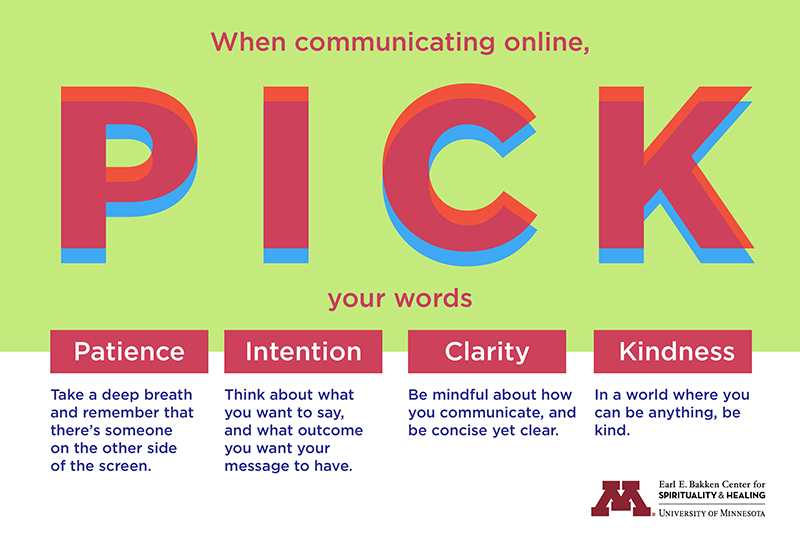
Try the P.I.C.K. Exercise
Patience
Patience is a quality that is now more important than ever. Being patient helps us look more at long-term goals and less on short-term setbacks, it can make us more resilient, and can even help us learn to cultivate more gratitude.
 In the two scenarios outlined above, the people in these hypothetical situations are experiencing a great deal of stress. However, the people they are interacting with are also likely experiencing stressors that are just as important - and impactful - to them.
 As you read an infuriating email or social media post, give people more room than you’d normally be inclined to give. Then give them more still.
Everyone reacts differently to stressful situations, but you have the power within yourself to take a deep breath and remember that on the other side of any online or in-person conversation is a human who is experiencing many of the same stressors you are feeling.
Read more: Mindfulness as a Tool to Navigate Conflict
Intention
 It’s always a good idea to avoid assuming the sender’s intention when you’re reading an email. After all, their message could mean a variety of things. Their simple response of “Let’s discuss later” to your well-crafted message sharing your best idea ever could mean a variety of things, including:
- “I’m not interested in this discussion.”
“I don’t understand this, so let’s talk about it some more.”
Or it could actually mean, “I’m reading this on my phone in between meetings and I look forward to discussing it with you later.”
In the PICK exercise, however, “intention” refers to the practice of setting the intention of your own message before crafting it.
Exactly what would you like to say in your message? How would you like to respond? What point would you like to make? How can you ensure that the receiver understands your message as you intended it to be received? “Setting an intention” is an ages-old mindfulness practice that can easily be brought into digital communication.
As you compose your message, consider what you would like the outcome to be, and how you can best convey that desired outcome.
Clarity
 In her book Dare to Lead, Brené Brown writes, that “Clear is kind. Unclear is unkind.” To use the previous example, the response of “Let’s discuss later” could have been far more clear and direct. Whenever possible, try to ensure that the recipient of your message understands your perspective. And always remember the Communications 101 rule:
Concise is best.
Keep in mind that during our time of expected fast replies that people deeply dislike jargon and corporate acronyms.
Consider clarity in your emails and your social media posts - and your in-person interactions - a kindness that you can share with others; by taking a mindful moment to re-read your message before you hit the send or post button, you’re doing your best to ensure a positive outcome for both the sender and the receiver.
Kindness
Finally, as you send your message or your post, be kind. A comprehensive study from MIT found that in social media, false news and lies spread faster than the truth. Oddly, in this study, news generated by bots seemed to spread at an equal pace whether positive or negative, while false news spread much faster via human connections, most likely due to an emotional response.
Studies have suggested that kindness boosts happiness, yet it seems hard to be kind to others in an online world where meanness can be cathartic or offer a sense of control.
As you begin to respond to communications from others in snarky ways, consider the impact that it will have on them, and also on yourself. Being kind to others benefits not only them, but you, too.
Kindness can also make you a better leader!
And in the end, isn’t it better – and more productive – to focus your limited energy during a time of global upheaval on making the world a better place, not just for you, but for your colleagues, loved ones, and generations to come? In a world where you can be anything, be kind. This doesn't mean you should avoid sharing difficult news or messages - but when doing so, be empathetic, and frame messages in kindness.